Saudi
Saudi Dubai
Dubai Kuwait
 Toronto
 London, UK
 India
India
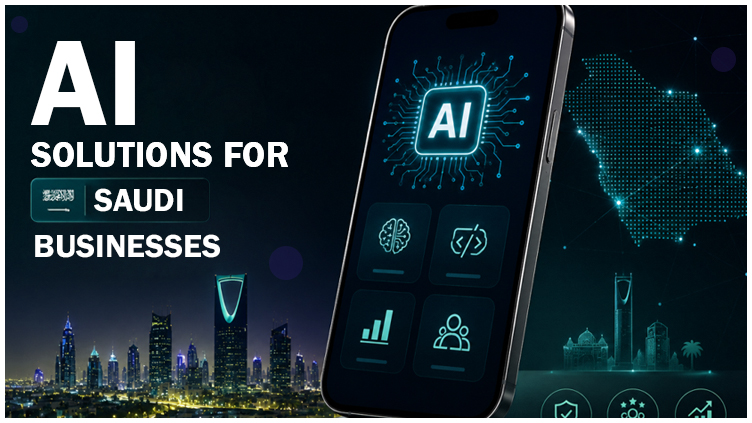
AI Solutions for Saudi Businesses: Real Use Cases Beyond Chatbots
Ask most Saudi business owners what "AI" means for their company, and the answer is usually the same: a chatbot on the website or WhatsApp. That's fair — chatbots were the easiest entry point, and thousands of Saudi SMEs adopted them over the past few years.
But chatbots are the smallest part of what AI can actually do for a business.
The real value of AI shows up in the parts of your business that never make it to a customer-facing screen: the warehouse that runs out of stock every Ramadan, the finance team that manually checks invoices for three days a month, the sales team chasing leads that were never going to convert, the delivery fleet burning fuel on routes that don't make sense.
Saudi Arabia is investing seriously in this shift. Under the National Strategy for Data and AI, led by the Saudi Data and AI Authority (SDAIA), the Kingdom has committed roughly SAR 75 billion (around $20 billion) toward AI development through 2030, and SDAIA projects that AI could contribute as much as 12% of Saudi Arabia's GDP by the end of the decade. This isn't a government-only initiative — it's a market signal. Banks, retailers, logistics companies, hospitals and real estate developers across the Kingdom are already building AI into daily operations, not just marketing pages.
This article looks past the chatbot and walks through the practical, revenue-and-cost-impacting use cases Saudi businesses are actually implementing today.
Why AI Matters for Saudi Businesses Specifically
A few local factors make AI adoption more relevant in Saudi Arabia than in many other markets right now:
- Vision 2030 is pushing digital transformation across every sector — from healthcare and logistics to construction and finance — which means AI-ready businesses have an easier time winning government and enterprise contracts.
- Labor costs and workforce Saudization requirements make automation of repetitive back-office work (data entry, document checks, scheduling) financially attractive, freeing Saudi staff for higher-value roles.
- Arabic-first customer bases need AI tools that understand Arabic dialects properly, not just translated English models — a gap most global AI tools still don't close well.
- Extreme demand seasonality — Ramadan, Hajj, Eid, back-to-school, National Day — makes accurate demand forecasting far more valuable here than in markets with flatter demand curves.
- Rapid urban and giga-project growth (NEOM, Qiddiya, Red Sea Project, Riyadh expansion) is creating logistics, construction and real estate complexity that manual planning can't keep up with.
In short: AI in Saudi Arabia isn't a "nice to have" trend. It's becoming a baseline expectation for businesses that want to compete for enterprise and government contracts, and a real cost-saver for SMEs trying to do more with lean teams.
12 Real AI Use Cases for Saudi Businesses (Beyond Chatbots)
1. Workflow & Business Process Automation
What it does: AI-powered automation handles repetitive, rule-based tasks — approvals, data entry, report generation, HR onboarding — without a person clicking through the same steps every day.
Saudi example: A Riyadh-based trading company automating purchase order approvals across multiple branches, so a PO that used to take three days to route through finance and procurement now clears in under four hours, with AI flagging only the exceptions that need human review.
Why it matters: Saudi SMEs often run lean teams. Automating the boring 80% of a process lets employees focus on the 20% that actually needs judgment.
2. Demand Forecasting
What it does: AI models analyze historical sales, seasonality, weather, and local events to predict what customers will buy — and when.
Saudi example: A supermarket chain in Jeddah using demand forecasting to prepare for the sharp spike in grocery buying before Ramadan and the drop immediately after Eid, instead of relying on last year's spreadsheet and gut feeling.
Why it matters: Saudi retail has some of the sharpest seasonal demand swings in the region. Getting forecasting wrong means either empty shelves or wasted stock.
3. Inventory & Stock Optimization
What it does: AI continuously analyzes stock movement, supplier lead times, and sales velocity to recommend reorder points and reduce both stockouts and overstocking.
Saudi example: A pharmacy chain operating across Riyadh and Dammam using AI-driven inventory optimization to avoid medicine shortages during high-demand periods while cutting excess stock of slow-moving SKUs.
Why it matters: Import lead times into Saudi Arabia can be long. Smarter inventory planning reduces both cash tied up in stock and the risk of running out.
4. Document Processing & Data Extraction
What it does: AI reads and extracts data from invoices, contracts, ID documents, and customs paperwork — turning scanned PDFs into structured, usable data automatically.
Saudi example: A logistics company processing customs and shipping documents at Jeddah Islamic Port, where AI extracts shipment details from hundreds of documents daily instead of a team manually re-typing data into ERP systems.
Why it matters: Saudi businesses dealing with government paperwork, customs, and Arabic-English bilingual documents lose enormous time to manual document handling. AI extraction cuts this from hours to minutes.
5. Lead Scoring & Sales Prioritization
What it does: AI analyzes lead behavior — website visits, WhatsApp engagement, past purchase history — to score which leads are most likely to convert, so sales teams focus effort where it counts.
Saudi example: A real estate developer in Riyadh using AI lead scoring to identify which property inquiries from Instagram and WhatsApp campaigns are genuine buyers versus casual browsers, improving sales team efficiency during launch periods.
Why it matters: Saudi businesses often generate high lead volume through social media and WhatsApp. Without scoring, sales teams waste time chasing unqualified contacts.
6. eCommerce Personalization
What it does: AI recommends products, adjusts pricing, and personalizes the shopping experience based on individual customer behavior rather than showing every visitor the same storefront.
Saudi example: A Saudi fashion eCommerce brand using AI-driven product recommendations to increase average order value during Riyadh Season and White Friday sales, when traffic spikes and manual merchandising can't keep up.
Why it matters: Saudi eCommerce is growing quickly, and personalization is one of the highest-ROI AI applications for online retail — directly increasing conversion and basket size.
7. Anomaly & Fraud Detection
What it does: AI monitors transactions, network activity, or operational data in real time and flags unusual patterns that could indicate fraud, error, or system failure.
Saudi example: A fintech or payments company in Saudi Arabia using anomaly detection to flag suspicious transaction patterns in real time, supporting compliance with SAMA's cybersecurity and anti-fraud expectations.
Why it matters: As digital payments grow rapidly in the Kingdom, fraud risk grows with it. Early detection protects both revenue and customer trust.
8. Business Intelligence & Predictive Analytics
What it does: AI-powered BI tools go beyond dashboards showing what happened — they predict what's likely to happen next, based on real operational data.
Saudi example: A manufacturing company in the Eastern Province using predictive analytics to forecast equipment maintenance needs before a breakdown halts production, rather than reacting after the fact.
Why it matters: Saudi enterprises investing in Vision 2030–aligned growth need forward-looking insight, not just historical reporting, to plan capacity and investment decisions.
9. Arabic Natural Language Processing (NLP)
What it does: AI models trained specifically to understand Arabic — including Saudi dialect, mixed Arabic-English text, and regional expressions — rather than relying on generic translated models.
Saudi example: A customer service team using Arabic NLP to automatically categorize and route customer complaints written in Saudi dialect across social media and WhatsApp, instead of manually reading every message.
Why it matters: Most global AI tools are trained primarily on English and Modern Standard Arabic, missing the dialectal Arabic that Saudi customers actually write in. This is a genuine local advantage for businesses that get it right — and a stated research priority for SDAIA's own AI programs.
10. AI-Enhanced ERP & CRM Systems
What it does: AI layered on top of existing ERP and CRM platforms adds predictive alerts, smart data entry, and automated recommendations directly inside the systems teams already use daily.
Saudi example: A distribution company integrating AI into its ERP to automatically flag slow-paying customers before they become bad debt, and to recommend optimal reorder quantities directly inside the existing SAP or Odoo dashboard.
Why it matters: Saudi businesses have already invested heavily in ERP and CRM systems. Adding AI on top delivers new value without ripping out existing infrastructure.
11. Logistics & Route Optimization
What it does: AI calculates the most efficient delivery routes and fleet schedules in real time, factoring in traffic, distance, delivery windows, and fuel cost.
Saudi example: A last-mile delivery company in Riyadh using AI route optimization to reduce delivery times and fuel costs during high-order periods like Ramadan and White Friday, when order volumes multiply overnight.
Why it matters: With rapid urban growth and giga-projects reshaping Saudi cities, static delivery routes quickly become outdated. AI adapts continuously.
12. Predictive Maintenance for Equipment & Facilities
What it does: AI monitors equipment sensor data (vibration, temperature, usage hours) to predict failures before they happen, rather than relying on fixed maintenance schedules.
Saudi example: A construction equipment operator on a giga-project site using predictive maintenance to schedule repairs before a crane or excavator breaks down mid-project, avoiding costly delays.
Why it matters: With billions of riyals tied up in NEOM, Qiddiya and other giga-projects, unplanned equipment downtime is extremely expensive. Predictive maintenance protects both budget and timeline.
AI Use Cases by Industry
|
Industry |
Top AI Use Cases |
Business Impact |
|
Retail |
Demand forecasting, inventory optimization, eCommerce personalization |
Fewer stockouts, higher average order value |
|
Logistics |
Route optimization, document processing, demand forecasting |
Lower fuel cost, faster customs clearance |
|
Manufacturing |
Predictive maintenance, anomaly detection, BI & analytics |
Less downtime, better production planning |
|
Healthcare |
Document processing, Arabic NLP, predictive analytics |
Faster patient records handling, better resource planning |
|
Real Estate |
Lead scoring, predictive analytics, workflow automation |
Higher-quality leads, faster deal cycles |
|
Finance |
Fraud/anomaly detection, AI-enhanced CRM, predictive analytics |
Reduced fraud losses, better credit decisions |
|
Hospitality |
Demand forecasting, personalization, workflow automation |
Optimized pricing, smoother guest operations |
|
Construction |
Predictive maintenance, document processing, BI & analytics |
Reduced downtime, better project cost control |
How to Start an AI Project: A Step-by-Step Approach
Most failed AI projects don't fail because of the technology — they fail because businesses start in the wrong place. Here's a realistic sequence:
Step 1: Identify One High-Impact, Low-Complexity Problem
Don't start with "we need AI." Start with "our inventory forecasting is costing us money" or "our team spends 10 hours a week on manual invoice entry." Pick one specific, measurable pain point.
Step 2: Audit Your Data
AI is only as good as the data behind it. Check whether the data you need (sales history, customer records, operational logs) actually exists, is accessible, and is reasonably clean.
Step 3: Define Success Metrics Before You Build
Decide upfront what "working" looks like — time saved, cost reduced, accuracy improved — so you can measure ROI honestly instead of judging the project on how impressive the demo looks.
Step 4: Start With a Pilot, Not a Company-Wide Rollout
Test the AI solution in one branch, one department, or one process first. Learn, adjust, then scale.
Step 5: Integrate With Existing Systems
The AI solution should plug into your existing ERP, CRM, or POS system — not force your team to work in a second, disconnected tool.
Step 6: Train Your Team and Assign Ownership
AI projects succeed when someone inside the business owns the outcome, not just the vendor. Make sure staff understand how to use, question, and improve the system.
Step 7: Monitor, Retrain, and Scale
AI models need periodic retraining as your business and market conditions change — especially around seasonal shifts like Ramadan or major sales events.
AI Security, Data Privacy & Governance in Saudi Arabia
AI adoption in Saudi Arabia doesn't happen in a regulatory vacuum. Businesses need to plan for compliance from day one, not as an afterthought:
- Personal Data Protection Law (PDPL): Saudi Arabia's PDPL, enforced by SDAIA, governs how personal data is collected, processed, and stored. Any AI system handling customer data — names, phone numbers, purchase history — needs to comply with PDPL requirements, including data localization considerations for certain sectors.
- SAMA regulations for financial data: Businesses in banking, fintech, and insurance must align AI systems handling financial data with Saudi Central Bank (SAMA) cybersecurity and data governance frameworks.
- Data residency: Depending on sector and data sensitivity, some Saudi organizations are required or strongly encouraged to host data within the Kingdom rather than on foreign cloud infrastructure.
- Model transparency and explainability: For AI used in lending, hiring, or other decisions affecting people, businesses should be able to explain how the AI reached its recommendation — not treat it as an unquestionable black box.
- Access control and audit trails: Any AI system touching sensitive business or customer data should have clear logging of who accessed what, and when.
Businesses that build governance into their AI projects from the start avoid costly rework later — and build more trust with Saudi regulators, partners, and customers.
How to Choose an AI Development Company in Saudi Arabia
Not every AI vendor is right for every business. When evaluating an AI development company in Saudi Arabia, look for:
- Proven experience with Saudi-specific requirements — Arabic language handling, PDPL compliance, and integration with locally used ERP/CRM systems.
- A track record of finished, working projects — not just demos or proof-of-concepts that never made it to production.
- Willingness to start small — a company pushing you toward a large, expensive engagement before proving value with a pilot is a red flag.
- In-house technical depth — not just a sales team reselling a generic AI product with no customization capability.
- Clear communication about data ownership — you should own your data and models, not be locked into a vendor's proprietary black box.
- Post-launch support — AI systems need maintenance, monitoring, and retraining; make sure this is part of the agreement, not an afterthought.
Asking a potential partner to walk you through a past project — the problem, the data used, the result, and what didn't work — tells you more than any sales pitch.
How Sapphire Technologies Can Help
Sapphire Technologies works with Saudi businesses on the practical side of AI adoption — the part that happens after the strategy slide deck.
Our team builds and integrates:
- AI and machine learning solutions tailored to specific business problems — forecasting, document processing, anomaly detection, and predictive analytics — rather than generic, off-the-shelf models.
- Custom software development for businesses that need AI capabilities built directly into their existing tools, rather than bolted on as a separate system.
- ERP and CRM integration, adding AI-driven insights and automation into systems your team already uses daily.
- Workflow and business process automation, reducing manual, repetitive work across finance, operations, and customer service.
- Web and mobile application development, including AI-powered features like personalization, smart search, and in-app recommendations.
We work directly with Saudi businesses to identify a realistic starting point, build a working pilot, and scale what proves valuable — rather than promising a company-wide AI transformation on day one.
Talk to Our Team About Your AI Project →
Frequently Asked Questions
1. What are the most practical AI solutions for Saudi businesses right now?
Workflow automation, demand forecasting, inventory optimization, and document processing tend to deliver the fastest, most measurable returns for Saudi SMEs and enterprises — often before more advanced use cases like predictive analytics or Arabic NLP.
2. Is AI only useful for large enterprises in Saudi Arabia?
No. Many of the highest-ROI AI use cases — inventory optimization, lead scoring, document processing — are especially valuable for SMEs with lean teams, since they free up staff time without requiring a large headcount increase.
3. How much does an AI project typically cost for a Saudi business?
Costs vary widely based on scope. A focused pilot (for example, automating invoice processing for one department) is significantly less expensive than a company-wide AI transformation. Starting with a small, well-defined pilot is usually the most cost-effective approach.
4. Does AI in Saudi Arabia need to comply with data protection laws?
Yes. Any AI system processing personal or financial data must align with Saudi Arabia's Personal Data Protection Law (PDPL) and, for financial services, SAMA's regulatory requirements.
5. Can AI actually understand Saudi Arabic dialect, not just formal Arabic?
Increasingly, yes — but not all AI tools handle this well. Purpose-built Arabic NLP models, including dialect-aware ones, perform significantly better than generic translated models for Saudi customer service and social media monitoring.
6. How long does it take to implement an AI solution?
A focused pilot project can often be built and tested within 6–12 weeks. Larger, integrated AI systems (ERP-embedded forecasting, company-wide automation) typically take 3–6 months depending on data readiness and integration complexity.
7. Do we need to replace our existing ERP or CRM to use AI?
Usually not. Most AI solutions can be integrated directly into existing ERP and CRM systems rather than requiring a full replacement.
8. What data do we need before starting an AI project?
This depends on the use case, but generally you need historical, reasonably clean data relevant to the problem — sales history for forecasting, customer records for lead scoring, or document samples for extraction projects.
9. How do we measure whether an AI project is actually working?
Define success metrics before starting — time saved, error reduction, cost savings, or revenue increase — and measure against them after the pilot phase, rather than judging success subjectively.
10. Beyond chatbots, what's the single best AI starting point for a Saudi SME?
For most Saudi SMEs, workflow automation or document processing offers the fastest, lowest-risk starting point, since it targets a clearly measurable time and cost saving without requiring complex data infrastructure.
Sapphire Technologies helps Saudi businesses build practical AI, automation, and custom software solutions — from pilot to scale. Serving businesses across Saudi Arabia, the wider Middle East, and international markets.