Saudi
Saudi Dubai
Dubai Kuwait
 Toronto
 London, UK
 India
India
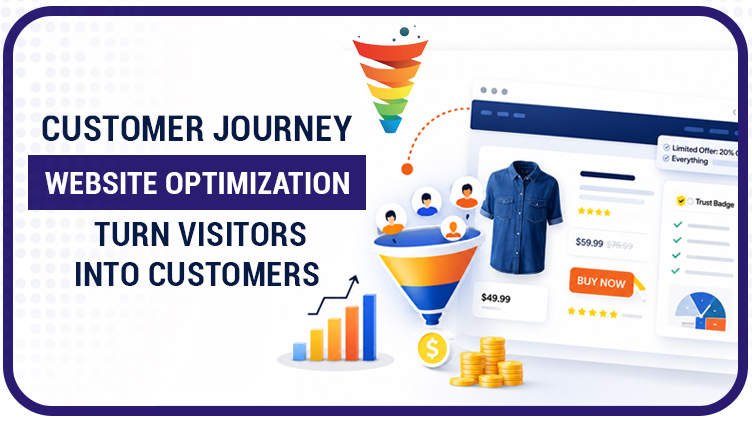
Customer Journey Website Optimization: Turn Visitors into Customers
Table of Contents
1. Introduction: Why Your Website Isn't Converting
2. Understanding the Customer Journey Website
3. Stage 1: Awareness - Making a Great First Impression
4. Stage 2: Consideration - Building Trust and Credibility
5. Stage 3: Decision - Removing Friction
6. Stage 4: Purchase - Making It Easy to Buy
7. Stage 5: Loyalty - Turning Customers Into Advocates
8. Measuring Your Customer Journey Website Performance
9. FAQ Section
Introduction: Why Your Website Isn't Converting
Here's a frustrating reality: Your website gets thousands of visitors every month, but only a tiny fraction becomes customers.
You optimize for traffic. You drive more clicks. You invest in advertising. But the conversion rate stays stuck at 1-2%. Something is broken, but it's not what you think.
The problem isn't your traffic. The problem is your customer journey website.
Most websites treat visitors like they're all identical. Everyone sees the same message. Everyone follows the same path. But the truth is: customers at different stages of their buying process need completely different experiences.
Someone visiting your site for the first time needs education and trust-building. Someone ready to buy needs simplicity and reassurance. Someone already a customer needs support and reasons to recommend you.
When you design your website experience around the actual customer journey, conversions don't just improve—they transform.
This guide shows you exactly how.
Understanding the Customer Journey Website
What Is Customer Journey Website Optimization?
Customer journey website optimization is the process of designing and refining your website to meet customers' needs at each stage of their buying process—from initial awareness through post-purchase loyalty.
It's not about moving people through your sales funnel. It's about understanding where they are in their buying journey and providing exactly what they need at that moment.
The Five-Stage Journey
Stage 1: Awareness — "I have a problem. I need a solution."
Stage 2: Consideration — "There are options. Which one is best?"
Stage 3: Decision — "I'm ready to buy. Do I trust this company?"
Stage 4: Purchase — "How do I buy? Make it easy."
Stage 5: Loyalty — "How do I stay connected? How do I tell others?"
Each stage requires different content, different messaging, and different calls-to-action on your customer journey website.
Stage 1: Awareness - Making a Great First Impression
The Challenge
Your first-time visitor has a problem. They don't know you exist. They're considering multiple solutions. They have perhaps 10 seconds to decide if your website is worth their time.
What Visitors Need
Clarity About What You Do — Explain your offer in plain language. No jargon. No clever wordplay. Just straightforward explanation of what you offer and who it's for.
Immediate Value Proposition — Why should they stay? What problem do you solve? Why does it matter? Answer these within the first sentence.
Relevant Content — Show educational content addressing their specific problem. Blog posts, videos, guides—resources that help them understand their options.
Customer Journey Website Strategy
Homepage Clarity: Your homepage headline should clearly state what you do and who you serve. "Marketing automation software for B2B SaaS companies" beats "The future of marketing" every time.
Content Hub: Create a resource center addressing questions people ask when they first learn about your category. A financial advisor creates content about "retirement planning basics." A software company creates content about "choosing the right project management tool."
Value-Driven CTAs: Don't ask for the sale. Ask for engagement. "Watch our 5-minute explainer" or "Read our free guide" or "Join 10,000+ subscribers learning about [topic]."
Reduce Friction: Make it easy to explore. Clear navigation. Fast-loading pages. Mobile-optimized design. Remove anything that slows down browsing.
Stage 2: Consideration - Building Trust and Credibility
The Challenge
Your visitor is now comparing you to competitors. They're evaluating whether you're legitimate, competent, and trustworthy. Trust determines whether they move forward or visit a competitor.
What Visitors Need
Social Proof — Real customers saying real things about your business. Testimonials, case studies, reviews, trust badges.
Evidence of Expertise — Awards, certifications, years in business, industry recognition. Proof that you know what you're doing.
Clear Differentiation — Why you over competitors? What makes you different? Be specific.
Educational Content — Deep-dive guides, comparison articles, webinars. Show your expertise by helping them make an informed decision.
Customer Journey Website Strategy
Testimonials & Case Studies: Feature 3-5 customer testimonials prominently. Make them specific: "Increased revenue by 40%" beats "Great company." Better yet, include customer names and photos—authenticity matters.
Company Credibility Section: Years in business, team member bios, certifications, awards. A well-designed "About Us" page builds confidence.
Comparison Content: Help visitors understand how you compare to alternatives. A transparent comparison actually builds trust—it shows you're confident in your value.
Educational Resources: Webinars, email courses, downloadable guides. Give away your knowledge. The value builds trust and positions you as an expert.
Free Trials or Consultations: Let them experience your value without risk. No trial? No consultation? You're forcing them to buy faith, which most won't do.
Stage 3: Decision - Removing Friction
The Challenge
Your visitor is ready to make a decision, but they have final doubts. They're asking: Is this the right choice? Am I making a mistake? How do I know this will work for me?
What Visitors Need
Clear Pricing — Know what it costs upfront. Hidden pricing kills conversions. Transparent pricing builds trust.
Detailed Product Information — Exact features, specifications, what's included. Answer every question they might have.
Risk Reversal — Money-back guarantees. Free trials. Warranties. Remove their risk of buying.
Proof It Works — Success stories, before-and-after results, metrics. Show that customers actually get the promised results.
Customer Journey Website Strategy
Pricing Page: Show clear pricing. Explain what each tier includes. Make comparing options easy. Add FAQ addressing common price objections.
Detailed Product Pages: For each service or product, create a comprehensive page showing exactly what customers get. Use images, videos, specifications.
Trust Badges: Security certifications, money-back guarantees, satisfaction guarantees. These reduce perceived risk.
ROI Calculator: If applicable, let customers calculate their return. A software company might offer "See your annual savings." A course creator might offer "Calculate your income increase potential."
Testimonials with Results: Go beyond "I loved working with them." Feature testimonials showing specific results: "Increased conversions by 32%," "Saved 10 hours weekly," "Reduced customer acquisition cost by 45%."
Stage 4: Purchase - Making It Easy to Buy
The Challenge
Your visitor is ready to buy. Anything that adds friction now kills the sale. A complicated checkout. Confusing payment options. Unexpected fees. All cause abandonment.
What Visitors Need
Effortless Checkout — 1-3 steps maximum. Clear progress indicator. Mobile-optimized. Show exactly what they're paying.
Multiple Payment Options — Credit card, PayPal, Apple Pay, Google Pay, bank transfer. Different people prefer different methods.
Clear Terms — What happens after purchase? When do they get access? What's the cancellation policy? Answer these upfront.
Reassurance — SSL security badge. Privacy policy link. Money-back guarantee displayed one more time. Reduce last-minute hesitation.
Customer Journey Website Strategy
Streamlined Checkout: Analyze your checkout flow. Every step should serve a purpose. Ask only essential questions.
Cart Abandonment Recovery: People abandon carts all the time. Send follow-up emails reminding them of what they left behind. Offer a small discount.
Post-Purchase Clarity: Immediately after purchase, show exactly what happens next. "You'll receive a confirmation email within minutes." "Your account will be active within 24 hours." "Your order ships Tuesday." Clear expectations prevent buyer's remorse.
Live Chat Support: Make help available during purchase. Someone panicking about entering payment information might abandon if they can't get quick reassurance.
Stage 5: Loyalty - Turning Customers Into Advocates
The Challenge
The sale isn't the end—it's the beginning. Your biggest growth opportunity is turning customers into repeat buyers and referrers.
What Customers Need
Onboarding Support — Help them get maximum value quickly. Tutorial videos, welcome emails, quick-start guides.
Community & Connection — Facebook groups, user communities, events. Create space for customers to connect with each other.
Continued Value — Educational content, tips, industry insights. Keep delivering value beyond what they paid for.
Easy Referral — Make recommending you simple. Referral programs with clear incentives. Easy-share buttons. Referral links they can use without friction.
Customer Journey Website Strategy
Onboarding Email Sequence: Send 5-7 emails over 2 weeks helping them succeed with your product/service. Each email teaches one specific thing.
Knowledge Base: Create comprehensive documentation and FAQs. When customers can solve problems themselves, they stay happy.
Loyalty Program: Reward repeat purchases or referrals. "Every 5th purchase is 20% off." "Refer a friend, both get a discount."
Customer Community: Create a space where customers connect. Whether it's a Facebook group, online forum, or annual event, community increases loyalty.
Win-Back Campaigns: If customers haven't purchased recently, re-engage them. "We miss you. Here's a special offer for returning customers."
Measuring Your Customer Journey Website Performance
Key Metrics by Stage
Stage 1 (Awareness):
- Traffic sources
- Pages per session
- Time on site
- Bounce rate
Stage 2 (Consideration):
- Content downloads
- Time spent on key pages
- Lead capture rate
Stage 3 (Decision):
- Product page views
- Pricing page visits
- Comparison page engagement
Stage 4 (Purchase):
- Conversion rate
- Average order value
- Cart abandonment rate
- Payment success rate
Stage 5 (Loyalty):
- Repeat purchase rate
- Referral rate
- Customer lifetime value
- Net promoter score (NPS)
The Goal
Optimize each stage independently. If 50% of visitors bounce at Stage 1, fix that first. If your conversion rate at Stage 4 is low, simplify checkout. Focus on the bottleneck preventing progression.
Frequently Asked Questions
Q1: Which stage is most important?
A: Stage 3 (Decision) is often the bottleneck. Visitors make it past awareness and consideration but abandon at decision. Fix decision friction first.
Q2: How long does optimization take?
A: Initial improvements appear within weeks. Significant growth takes 3-6 months. Optimization is ongoing—you're always testing and improving.
Q3: What tools do we need?
A: Google Analytics 4 (free) tracks visitor behavior. Heat mapping tools (Hotjar) show where people click. A/B testing tools help you test changes. Session recording tools show exactly how people navigate.
Q4: Should every visitor see the same journey?
A: No. Segmentation is powerful. Returning visitors see different content than first-time visitors. B2B visitors see different messaging than B2C. Personalize based on visitor characteristics.
Q5: What if we're a services business, not a product?
A: The journey works identically. Instead of "purchase," Stage 4 is "booking a consultation" or "signing a contract." The principles remain the same.
Q6: How do we test changes without breaking conversions?
A: A/B testing. Change one element at a time. Route 50% of traffic to the old version, 50% to the new. Measure which wins.
Q7: How much traffic do we need to start optimizing?
A: Start with 500+ monthly visitors. Below that, sample size is too small for reliable data. But you can still implement best practices while you build traffic.
Q8: What's a good conversion rate?
A: Industry varies widely. Average is 2-3%. B2B typically 1-2%. E-commerce 1-3%. Your goal: 10-20% better than your current baseline.
Q9: Should we optimize for mobile first?
A: Absolutely. 65%+ of traffic is mobile. If mobile doesn't convert, overall conversions suffer.
Q10: How do we know if our optimization is working?
A: Compare metrics month-to-month. Traffic might stay flat while conversion rate increases—that's success. Revenue increasing is the ultimate metric.
Summary: Your Optimization Journey
Customer journey website optimization is the difference between adequate websites and exceptional ones. Adequate websites move people through. Exceptional websites guide them, support them, and delight them.
Start by mapping your actual customer journey. Understand where visitors come from, what they need at each stage, and why they leave.
Then optimize, stage by stage.
Your conversion rate won't double overnight. But in 3-6 months? Consistent optimization compounds. You'll look back and wonder how you ever ran your website the old way.
Ready to Optimize Your Customer Journey?
Sapphire Technologies specializes in customer journey website optimization. We analyze your current experience, identify bottlenecks, and implement proven strategies that turn visitors into customers and customers into advocates.
We handle the strategy, testing, and implementation. You focus on running your business.
Schedule Your Free Customer Journey Assessment →
Key Takeaways
✓ Customer journey website optimization means meeting customers where they are in their buying process
✓ Five stages require different content, messaging, and calls-to-action
✓ Stage 3 (Decision) is typically the biggest conversion bottleneck
✓ Optimization is ongoing—test, measure, improve, repeat
✓ Small improvements at each stage compound to dramatically higher conversions
✓ Your biggest growth opportunity is post-purchase loyalty and referrals